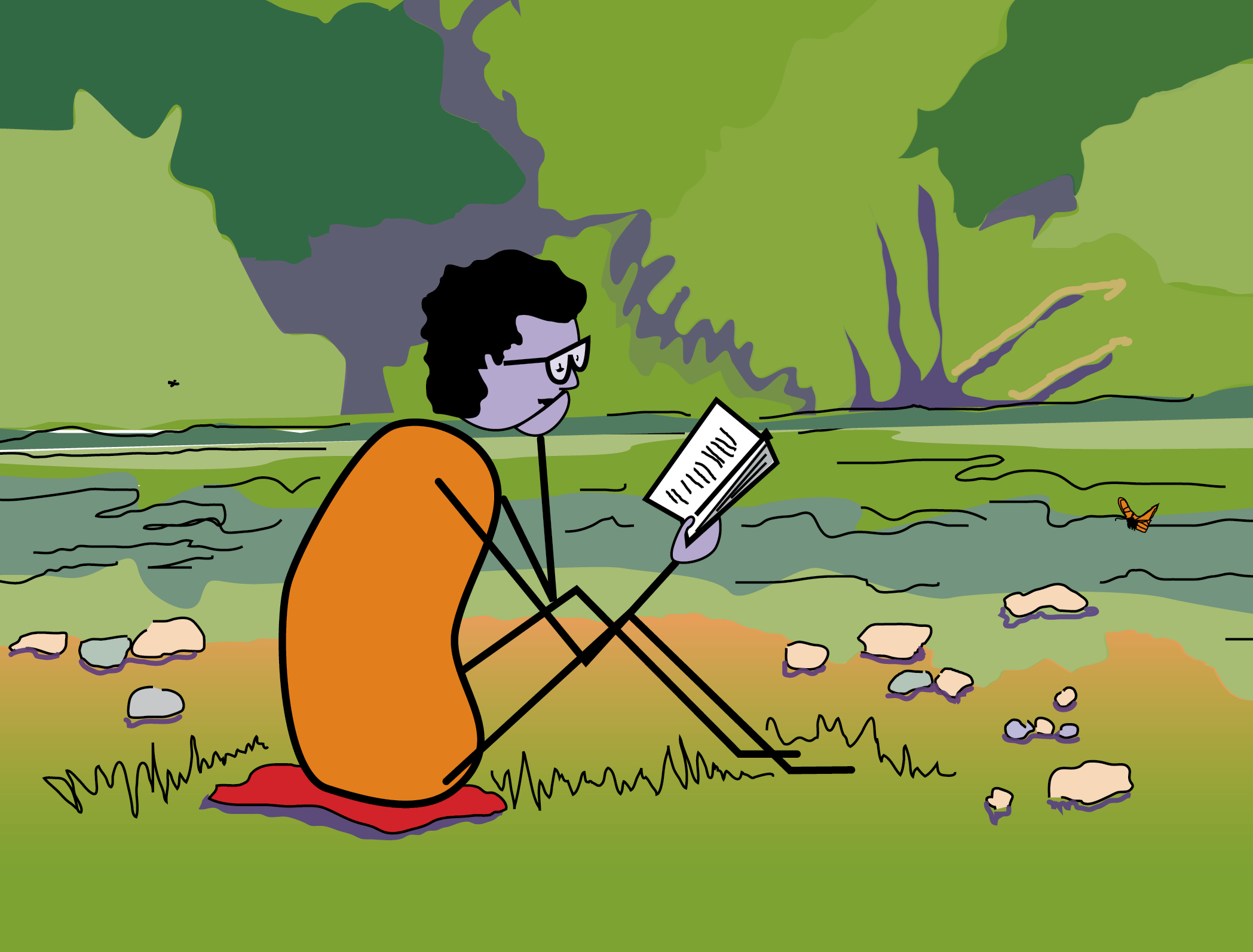
Reading retreats, whether solo affairs or group experiences, are trending as a vacation activity. For those of us who enjoy books, the trendiness of a reading vacation may seem silly, but it also validates reading while traveling as a legitimate activity rather than a guilty pleasure. And as the weather warms, readers take their pleasures outdoors.
Reading outdoors is nothing new. Every year, lists drop for the best summer beach reads. My Instagram feed populates with pictures of people reading paper books on the sand and in outdoor cafes. Two weeks ago, a friend who loves kayaking and camping in the Pacific Northwest posted a video of a brazen squirrel in her bag stealing pretzel bites. Also in her bag – a book.
People who enjoy reading make time for this pleasure whenever and wherever they are.
Vacations that center reading embody the principles of slow travel because they allow readers to linger in a place, to absorb and appreciate the local environment. If readers are outdoors, changes in weather and the presence of bugs are particularly noticeable when you’re camped in one spot.
Whether you’re outdoors or indoors, there’s a lot of information that your body receives about a place even when you might not be paying specific attention to your environment.
As a high school graduation gift in 1993, my uncle and aunt took me on a tour of national parks and monuments in the southwest: Mesa Verde, Monument Valley, Grand Canyon, Arches, Bryce Canyon, and Zion. The three of us hiked and sweated and spent a lot of time in the car traveling between sites.
We stopped at the overlook for Dead Horse Point, a tight bend in the Colorado River around stunning red bluffs. I hopped out of the car into the intense sun with my book, John McPhee’s Encounters with the Archdruid. We looked at the view and read the interpretive sign.
Beyond the overlook was a flattish rock where I sat and read with my legs dangling in the air, the river valley before me. The setting seemed fitting to continue reading about American wilderness and the contrast between purist and exploitative orientations to these natural resources.
“We came all this way and you’re reading?” Uncle John said with a note of exasperation. He stood in the shrubs behind me to the right. “Look at the view.” He gestured to the expanse before me.
He had a point, and while the view was spectacular, I wasn’t sure what more I was getting by continuing to look. Dead Horse Point appeared the same as when we first got there. Even if I had taken a picture of the place, I would have a picture like so many other people. It didn’t seem to matter if I could look at a photograph and think – oh, yeah, I was there.
The reflection of the bright sun on the pages was almost too much to bear as was McPhee’s reference to the natural wonder, Cathedral in the Desert, submerged in Lake Powell after construction of the Glen Canyon Dam.* I supposed it was possible that humans might dam the Colorado River here, too, and Dead Horse Point would cease to exist in the landscape. Maybe that’s why it was important to have a photo. It was proof. Evidence.
*In recent years, megadroughts in the American southwest have led to historic drops in Lake Powell water levels and exposed Cathedral in the Desert, enabling people to experience the wonder of this natural feature once again.
Years later, Uncle John presented a family slide show that included photos from that southwest trip, including a picture of me reading at Dead Horse Point. Admittedly, I was surprised to see myself there, looking down at the book. Was I being a bad tourist the way the photo suggested? Once I got over the shock of seeing myself in the photo not looking at the view, I recalled what had had my attention in that moment.
Much in my life has changed in the more than thirty years since my moment at Dead Horse Point. I don’t make nearly as much time to read books as I used to, but I still love the journey of turning pages and discovering the surprises they contain.
The first trip my partner, Barney, and I took once pandemic restrictions lifted was a winter getaway to an Airbnb about 80 miles from home. Since there were still restrictions on public gathering, we didn’t plan on doing much beyond the Airbnb. I took a stack of books.
Barney read three books while we were there. I read one.
Since then, I make a point to read during trips. Usually, I read during travel time – while waiting to board or on a train or plane (unfortunately, reading in a car or bus no longer agrees with me). And sometimes, reading is part of the pleasure of being away. During my last trip to Portland, Oregon, I had a whole day between the end of a writing workshop and scheduled friend meet ups. I barely left the Airbnb that precious Monday and read all of Bleaker House by Nell Stevens, which I’d picked up at Powell’s Books my first evening of the trip.
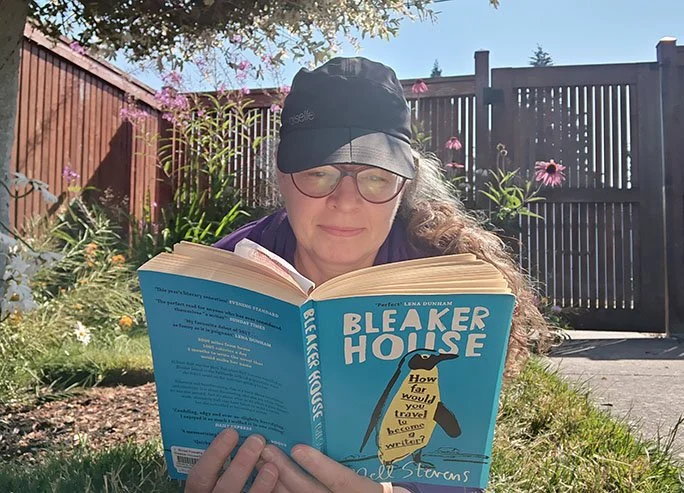
Bleaker House is set on the Falkland Islands in the South Atlantic where author Nell Stevens went for several months to write a novel. This memoir is a story about her failure to accomplish that goal and includes some fiction.
Part of what makes a good reading retreat location, according to Mackenzie Newcomb, CEO and Founder of Bad Bitch Book Club, “is a strong relaxation element and a great view.”** Cities and other tourism hotspots tend not to work as well for reading retreats because the enticement to go explore is at cross purposes with being in a beautiful place to read.
**“Why ‘slow travel’ is about to be 2026’s biggest vacation trend.”
I’m not the kind of person who can just sit outdoors by myself. If I’m not talking to a friend, I prefer to walk, make art, write, read, or pull weeds. All these activities, even just sitting or napping, are slow travel because they immerse you in the local environment. The travel aspect of slow travel doesn’t have to be grander than simply going outside. Anything you do outside will require your notice of the local environment.
One day late this spring, I took To Shake the Sleeping Self by Jedidiah Jenkins out to the front stoop to enjoy the blooms and warmth from the lowering sun. After a few pages, movement in the red flowering currant drew my attention away from the page. A hummingbird fed among the flowers, and I watched it until it flew off.
To Shake the Sleeping Self is about Jenkins’ 2013 bike tour from Portland, Oregon, to Patagonia. Early in Chapter 3 while Jenkins and his riding companion are in California, they’re keen to take breaks to read: “We stopped a few times for hours at a time, hiding our bikes behind felled redwoods the size of shipping containers, and traipsing into the forest with our paperback books in search of a reading spot by a stream or in a sunbeam meadow. We found it. And we read” (42). Further south in Mazatlán, Jenkins reads on the beach. In Nexapa, he reads with his back against a palm tree with a view of the river. He reads in hostels and at homestays.
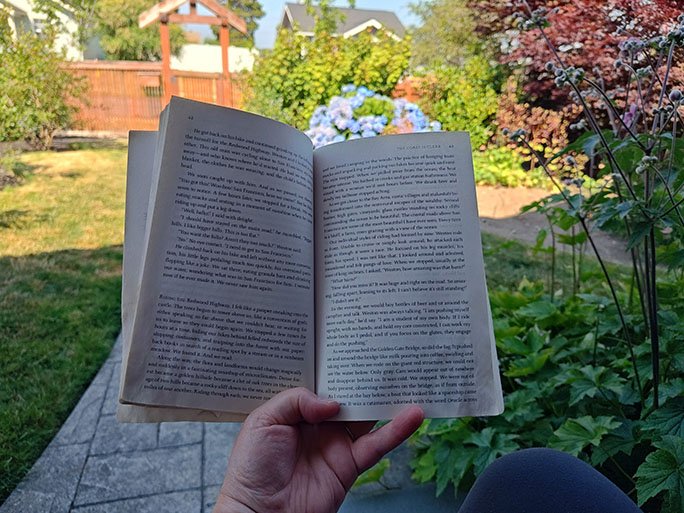
My copy of To Shake the Sleeping Self suffered water damage during a walk to an appointment in a downpour. The book was in a bag on my back under the protection of an umbrella. It rained that hard!
I love the urgency Jenkins has to read while traveling and how reading provides a reason for him to interrupt the schedule of travel with an activity that celebrates lingering. In this respect, the journey is the destination, and he found a way to further lengthen his time in and appreciation of beautiful places along the way.
Reading outdoors is one way to slow travel even if you’re only going as far as your stoop, porch, patio, balcony, or yard. Reading outdoors is also a way to have a deeper experience of place than can be had by taking pictures then leaving.
I invite you to indulge in reading outdoors this summer. Where and what did you read? What places would be on your Top Ten Places to Read Outdoors? What books would you pair with your recommended places?
More info on reading retreats and literary tourism:
“This Year’s Trendiest Vacation? A Reading Retreat” July 16, 2025. Elle
“How to plan a reading vacation” June 20, 2025. Romancing the Phone
“Why A ‘Reading Retreat’ Is The Girls’ Trip Idea You Need To Try This Year” March 27, 2026. The Everygirl
“Call It A ‘Book-cation’ or ‘Readaway.’ Literary Travel Is Having A Moment.” June 16, 2026. The New York Times
